Posts

3D Virtual Learning Worlds

  1.        https://www.thinglink.com/video/1732477096279671652 I am currently reading Jaqueline Wilson's update on the classic The Magic Faraway Tree to my 6 year old daughter Joni. Joni has a vivid imagination and a keen interest in 'words'. One evening last week we started playing on  Midjourney  with her sitting on my knee, to create some of her favourite characters. She told me exactly how she imagined them and we tried various prompt iterations until we got the characters just how she imagined them in her mind's eye. We then entered some of their images into  D-ID  to generate voice. Again, Joni decided which voice suited her favourite characters and we asked  ChatGPT  to help us script their words. She then described how she imagined the enchanted wood to look, with "pink trees", and "sparkly magic", so we picked the best 'descriptive words' she could come up with, and formulated another prompt for  Blockade Labs...

PADLET

Using Padlet in lessons for "warm-up our imagination" starter activities has proven to be really engaging and fun for students. 1.       https://en-gb.padlet.com/barrowt/bike-of-the-future-qc1crc7415535jq1 Students were asked to close their eyes and imagine a bike or motorbike for the future. They were encouraged to be as imaginative as possible, and then they opened their eyes and described it to their partner. Afterwards, they used the vocabulary they deemed most important to prompt the Gen AI function in Padlet. When presented with a handful of options, they selected the one that they thought was closest to their mind's eye (or altered their prompt until they were happy) and shared it with the rest of the class on the Padlet board. The Padlet board also shared their work in real-time on the main classroom screen. I also asked the students to copy and paste their prompts so the whole class could see them. 2.       https://en-gb.p...

MIDJOURNEY ( Image Generation)

In Design and Technology there are many ways we can harness the power of generative A.I image generation for our teaching and pedagogy. exemplar work; both 2D and 3D quick examples of drawing techniques and styles mood boarding example product disassembly fabric sample 'photographs' material sample 'photographs' recipes broken down into 'ingredient photos' sketches and renders card models laser cutting examples quick visualisations etc. etc. It goes without saying that not all of this is 'perfect' and we the teacher should choose our images carefully, but this could revolutionise the time we spend creating or sourcing resources for schemes and lessons. I've become fascinated in how we as teachers can use A.I visual generation to aid our work and to enable us to 'work smarter not harder'. We also obviously have a responsibility to model best practise in this area to our students who are also using A.I. (often upskilling in the tools at a fast...

Future-proofing D&T

Image
  I support Pearson’s conceptual proposal for ‘future-proofing’ design education. As a teacher of Design and Technology I am a passionate believer that sustainability and climate change education should be at the forefront of what we do, not simply a bolt-on to existing design and make projects currently taught in the majority of schools. D&T is often seen as the ‘problem solving’ subject; surely the most important problem to address is climate change. This should be part of the design education fundamentals, framing the way we teach, and what we teach. Our world is fundamentally under pressure due to climate change; a world which is built on a digital infrastructure and language like never before. The key to the future of our subject is equipping students to think like designers and critical consumers in the current and future world. As design educators we have a responsibility to equip our students with skills for the future. This means encouraging our students to become...

How is CPD received by different staff members?

I am very fortunate to work in a school which has a very robust CPD programme for staff. The school is supported by being a research school and a teaching school hub. These elements feed into a culture of growth for all staff that aims to centre around wellbeing. However through research and interviews I now think we could improve on one aspect of this. All staff are carefully guided through CPD provision that is tailored to them and their needs. The school starts the tailored CPD programme with a ‘market-place’ event which offers opportunities for staff to speak with specific experts and representatives from different CPD opportunities. These include the teaching school hub which runs subject specific networks and training programmes, the research school which offers webinars and face to face events distilling and analysing the latest research and the in-school coaching programme, which is new but proving to be very beneficial for staff at all stages of their career development. Gui...

Looking closely at 2 cognitive principles

Image
For my NPQLTD I have been asked to choose two cognitive principles from ‘The Science of Learning’ - Deans for Impact, 2015 and ‘reflect on their implications for the practice of teachers in my school’.  Rather than my school I have reflected on their implications for my subject. (I couldn’t help myself). Cognitive Principle 1: ‘Information is often withdrawn from memory just as it went in. We usually want students to remember what information means and why it is important, so they should think about meaning when they encounter to-be-remembered material .’ Practical implications for the classroom: ‘Teachers can assign students tasks that require explanation (e.g., answering questions about how or why something happened) or that require students to meaningfully organize material. These tasks focus students’ attention on the meaning of course content.’ In D&T teachers often require students to explain their design choices or justify their plans or specification points. As a...

Becoming an AEE for ATSH

Image
I’m passionate about my subject of Design and Technology. Becoming an AEE has given me the opportunity to share that passion with other colleagues and work with a wide range of teachers from different schools who are at different stages in their careers. I have thoroughly enjoyed leading the new D&T Teacher’s Network for the area and designing the content in a way that I would want to receive it. I also led training sessions for D&T ECTs at the regional day for secondary ECTs, again a thoroughly enjoyable and interesting experience. It felt a privilege to have an impact on the thinking of D&T teachers at the start of their careers. In the D&T Network this academic year we have been unpicking some of the big picture issues surrounding our subject. It was fantastic to see the discussions and debates that came from it amongst a team of motivated and enthused colleagues. We have considered issues that that often don’t get the time to be carefully considered due to press...

Craft - Reclaiming the Word

At a recent training event I was pulled up by one of the delegates by denigrating  the word ‘craft’. The subsequent discussion lead me to really reconsider the use of the word in the context of D&T and how craft is perceived in our subject. This came about as I was leading a session on ‘deep learning’ I was explaining the concept of the second 50% of excellent learning (the first 50% being engagement, motivation and determination) coming from opportunities for independence, critical thinking, problem solving and most importantly design thinking. I explained that I believe D&T teachers should remove scaffolds for design and make work overtime and ‘not simply create crafters who can follow instruction’. My point was that we often see D&T outcomes from KS3 lessons as deemed more important than the journey to get there. For example: If Jenny has a beautiful gift to give her Mum at Christmas time, has her learning automatically been more successful than Tom who’s product...

The second 50% - thoughts about moving to the next level of deep learning and understanding.

If the first 50% of excellent learning is engagement, what makes up the next 50% to make learning excellent? When training ECTs recently we were asked to delve into Rosenshine’s principles and unpick the following quotes: “Engagement is a poor proxy for learning” – Professor Rob Coe “Learning happens when people have to think hard” - Professor Rob Coe       “If nothing in the long-term memory has altered, nothing has been learned” – Sweller et al. I wanted to take a minute to consider what this all means for the D&T teacher and for myself as a classroom teacher. It is evident in many early career teachers that the first challenge is that of surviving the classroom and gaining the respect of the students in order to deliver the content of the lesson effectively. I have often heard teachers describe a lesson as a success when all students were on task throughout, the atmosphere was pleasant and the content was delivered in an interesting, varied way.   ...

Blended Assessment in D&T

Image
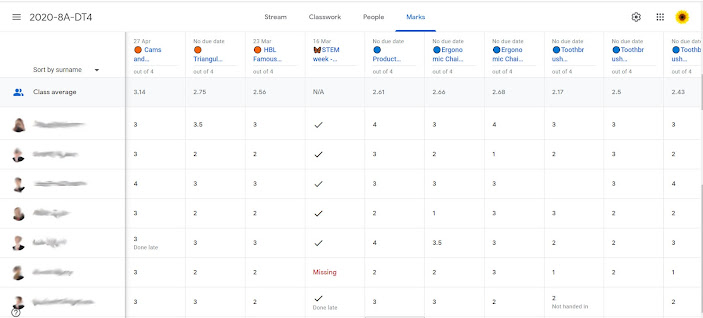
The introduction of blended learning into my classroom and then the abrupt switch to a virtual learning curriculum has had a huge impact on how I now assess students through both formative and summative assessment. I’m very interested in exploring how digital tools can help alleviate the time pressures and work load of marking on the teacher whilst providing students with personalised, targeted feedback that leads to exceptional progress. “feedback should cause thinking. It should be focused; it should relate to the learning goals that have been shared with the students; and it should be more work for the recipient than the donor. Indeed, the whole purpose of feedback should be to increase the extent to which students are owners of their own learning,” ― Dylan Wiliam,  Embedded Formative Assessment KS3 Digitally Marked Scheme of Learning The majority of formative assessment during a KS3 DT rotation has historically been in the form of handwritten comments. I’ve also tr...

The Importance of Design Presentation

Image
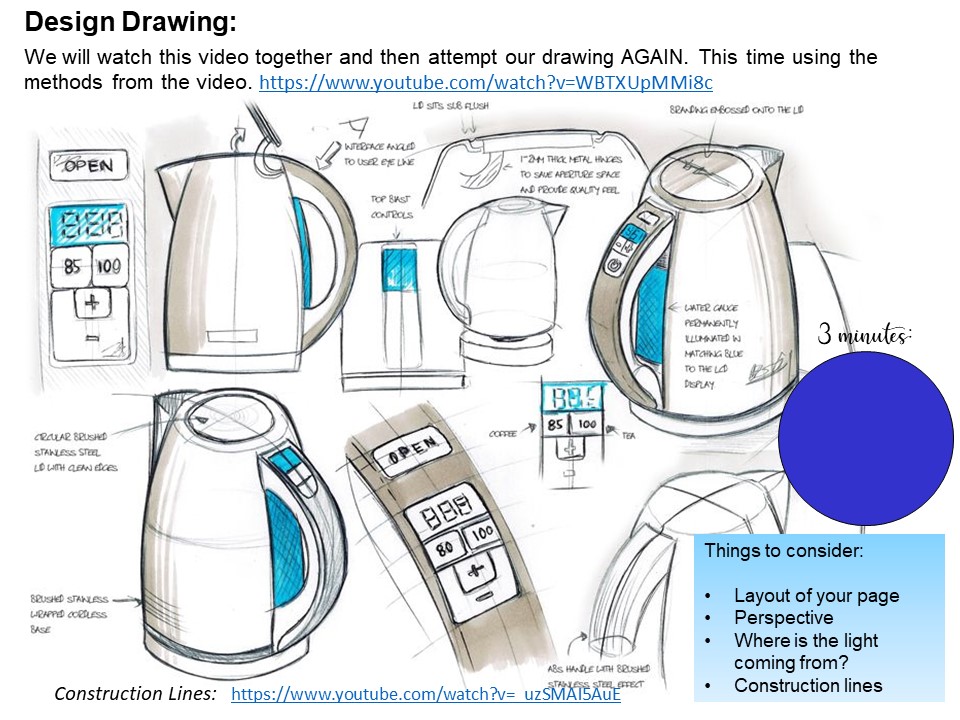
Exam boards no longer have a section of marks students can achieve for their presentation skills. My personal opinion is this is wrong as it has lead to pieces of coursework in KS4 and 5 being text heavy with often little teaching attention given to how to present ideas clearly and effectively. In professional design industries, design boards, models and portfolios are centre stage to group discussions and client pitches. To be able to effectively communicate visually is essential and goes hand in hand with creating excitement and engagement from the client. I talk about the 'wow' factor in my lessons and spend time discussing the need to 'attention grab' with the quality of presentation of design drawings. This is something students are often very confident with when using CAD but I fear hand sketching skills are taking a back seat. In my department we have recently invested in pro-markers and I have taught rendering skills to KS5 students. Not only has the presentatio...

The Stimulating Learning Environment

Image
It is a huge belief and passion of mine that the learning environment should be dynamic and exciting for students to learn in. Since re-joining the staff at Sandringham I have endeavoured to create interesting and exciting displays that above all are inspiring. This September I have taken stock of what I have managed to produce recently and am making plans to create more displays for the department over the next academic year. 

Year 9 STEM Assembly

Perseverance CLICK here for Year 9 Perserverance Assembly on Loom I really enjoyed making this assembly on the character trait of perseverance through looking at NASA's Perseverance Rover mission to Mars. I learnt a lot about NASA's space program and project Artemis I really want to return to this again in DT lessons. There could potentially be lots of cross curricular link opportunities and I was really impressed with the learning materials on NASA's website. 

STEM week

Image
 A small STEM week due to lockdown timing This year's STEM week at Sandringham School was smaller than it would have been due to it coinciding with the return to school after the second school closure of the year. I took a lead on planning the DT lessons for year 7&8 and liasing with the overall project lead. It was a shame we could not implement some of our whole school ideas but I look forward to next year!  Using padlet to create a competitive gallery This year's theme was biodiversity.  In DT students were asked to choose from 3 design briefs to  competitive design section of the lesson. The DT lessons were all tied together across the department using padlet. There were 5 simultaneously taught classes for half a year group at a time totaling 20 classes.  When all classes were complete and all students had uploaded their work an overall winner was chosen. The 3 padlets produced were full of work and students were able to see a live gallery and work being...

Using Padlet

A fantastic resource to be used in many different ways. In my lessons as a DT and Art teacher I very often use Padlet as it is a fantastic resource for showcasing visual work. I have also used Padlet to aid with peer assessment, to play ‘guess who’ games, and to offer a forum for quick fire questions with 6 th form. I have also started using it for starter activities within a google meet; posing a question that students can respond to whilst they wait for others to join the meet.   Here are some examples: ·         A year 8 Art Padlet. This Padlet was used for peer assessment . Students were to follow the assessment criteria also posted on the page. https://padlet.com/barrowt/y14ullp1gjc1h2ke ·         This is the same class playing a guess who game. Each student posted their final piece of their bedroom and then the others are guessed who it belonged to based on clues within the piece. From a project abou...

Blue Hearts for the NHS

Image
A project to say thank you with a visual collage from as many students as possible. Sandringham Students across all year groups joined together to create an artwork honouring and thanking our heroes in the NHS. I organised this in collaboration with both the Design Technology and the Visual Art Faculties, The project was organised as a starter activity in lessons. Students were asked to make a heart to thank the NHS. The only rule was that it was to be blue, but they were encouraged to use a wide range of materials and tools, which included traditional fine art techniques, photography, CAD, lego, textiles, digital methods and even snow. All of us involved were very impressed with the variety of designs submitted, and the passion from the students. It was so touching to see how much they wanted to thank NHS workers and our frontline heroes. For some students it was much closer to home with a family member on the front line they really wanted to thank. I delivered some A3 laminated print...