Posts

Becoming an AEE for ATSH

Image
I’m passionate about my subject of Design and Technology. Becoming an AEE has given me the opportunity to share that passion with other colleagues and work with a wide range of teachers from different schools who are at different stages in their careers. I have thoroughly enjoyed leading the new D&T Teacher’s Network for the area and designing the content in a way that I would want to receive it. I also led training sessions for D&T ECTs at the regional day for secondary ECTs, again a thoroughly enjoyable and interesting experience. It felt a privilege to have an impact on the thinking of D&T teachers at the start of their careers. In the D&T Network this academic year we have been unpicking some of the big picture issues surrounding our subject. It was fantastic to see the discussions and debates that came from it amongst a team of motivated and enthused colleagues. We have considered issues that that often don’t get the time to be carefully considered due to press...
Craft - Reclaiming the Word

At a recent training event I was pulled up by one of the delegates by denigrating  the word ‘craft’. The subsequent discussion lead me to really reconsider the use of the word in the context of D&T and how craft is perceived in our subject. This came about as I was leading a session on ‘deep learning’ I was explaining the concept of the second 50% of excellent learning (the first 50% being engagement, motivation and determination) coming from opportunities for independence, critical thinking, problem solving and most importantly design thinking. I explained that I believe D&T teachers should remove scaffolds for design and make work overtime and ‘not simply create crafters who can follow instruction’. My point was that we often see D&T outcomes from KS3 lessons as deemed more important than the journey to get there. For example: If Jenny has a beautiful gift to give her Mum at Christmas time, has her learning automatically been more successful than Tom who’s product...

The second 50% - thoughts about moving to the next level of deep learning and understanding.

If the first 50% of excellent learning is engagement, what makes up the next 50% to make learning excellent? When training ECTs recently we were asked to delve into Rosenshine’s principles and unpick the following quotes: “Engagement is a poor proxy for learning” – Professor Rob Coe “Learning happens when people have to think hard” - Professor Rob Coe       “If nothing in the long-term memory has altered, nothing has been learned” – Sweller et al. I wanted to take a minute to consider what this all means for the D&T teacher and for myself as a classroom teacher. It is evident in many early career teachers that the first challenge is that of surviving the classroom and gaining the respect of the students in order to deliver the content of the lesson effectively. I have often heard teachers describe a lesson as a success when all students were on task throughout, the atmosphere was pleasant and the content was delivered in an interesting, varied way.   ...

Blended Assessment in D&T

Image
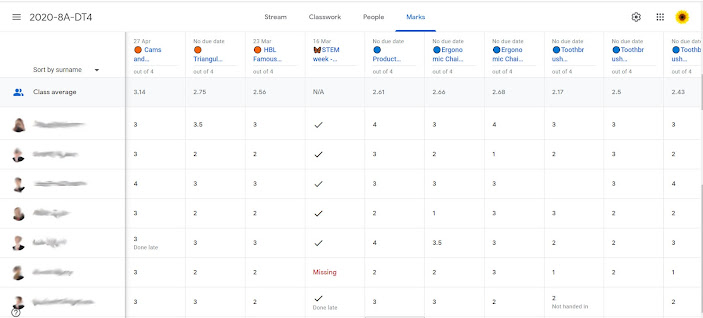
The introduction of blended learning into my classroom and then the abrupt switch to a virtual learning curriculum has had a huge impact on how I now assess students through both formative and summative assessment. I’m very interested in exploring how digital tools can help alleviate the time pressures and work load of marking on the teacher whilst providing students with personalised, targeted feedback that leads to exceptional progress. “feedback should cause thinking. It should be focused; it should relate to the learning goals that have been shared with the students; and it should be more work for the recipient than the donor. Indeed, the whole purpose of feedback should be to increase the extent to which students are owners of their own learning,” ― Dylan Wiliam,  Embedded Formative Assessment KS3 Digitally Marked Scheme of Learning The majority of formative assessment during a KS3 DT rotation has historically been in the form of handwritten comments. I’ve also tr...

The Importance of Design Presentation

Image
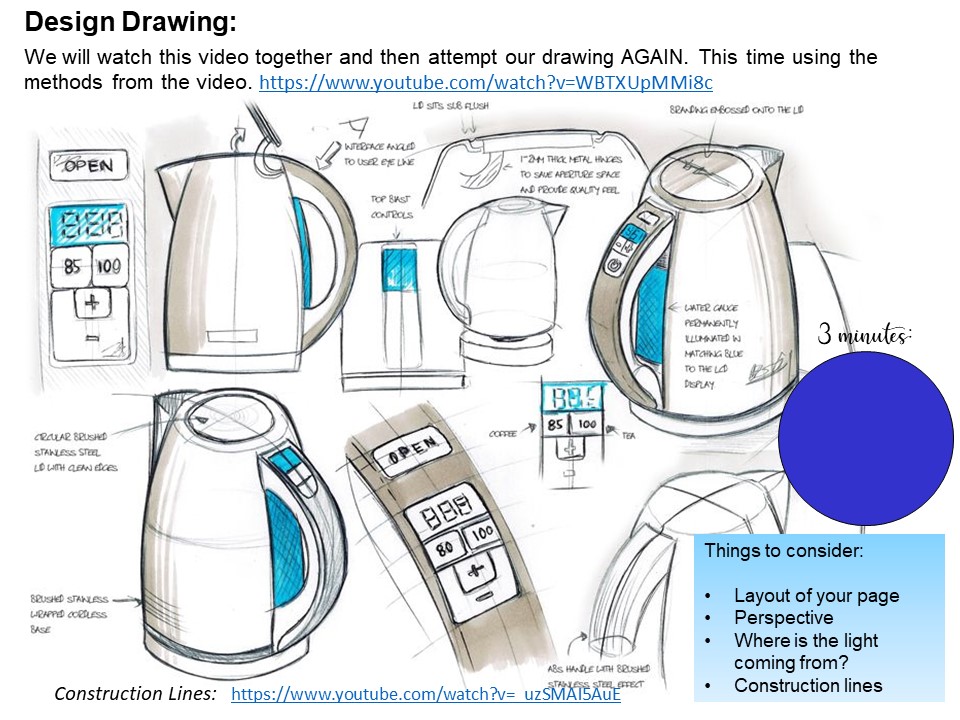
Exam boards no longer have a section of marks students can achieve for their presentation skills. My personal opinion is this is wrong as it has lead to pieces of coursework in KS4 and 5 being text heavy with often little teaching attention given to how to present ideas clearly and effectively. In professional design industries, design boards, models and portfolios are centre stage to group discussions and client pitches. To be able to effectively communicate visually is essential and goes hand in hand with creating excitement and engagement from the client. I talk about the 'wow' factor in my lessons and spend time discussing the need to 'attention grab' with the quality of presentation of design drawings. This is something students are often very confident with when using CAD but I fear hand sketching skills are taking a back seat. In my department we have recently invested in pro-markers and I have taught rendering skills to KS5 students. Not only has the presentatio...

The Stimulating Learning Environment

Image
It is a huge belief and passion of mine that the learning environment should be dynamic and exciting for students to learn in. Since re-joining the staff at Sandringham I have endeavoured to create interesting and exciting displays that above all are inspiring. This September I have taken stock of what I have managed to produce recently and am making plans to create more displays for the department over the next academic year. 

Year 9 STEM Assembly

Perseverance CLICK here for Year 9 Perserverance Assembly on Loom I really enjoyed making this assembly on the character trait of perseverance through looking at NASA's Perseverance Rover mission to Mars. I learnt a lot about NASA's space program and project Artemis I really want to return to this again in DT lessons. There could potentially be lots of cross curricular link opportunities and I was really impressed with the learning materials on NASA's website.